
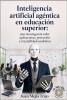
Inteligencia artificial agéntica en educación superior: Una investigación sobre aplicaciones, protocolos y trazabilidad académica
Palabras clave:
Inteligencia artificial agéntica, educación superior, trazabilidad académica, protocolos universitariosSinopsis
El libro Inteligencia artificial agéntica en educación superior: una investigación sobre aplicaciones, protocolos y trazabilidad académica analiza cómo la IA agéntica puede apoyar los procesos universitarios sin sustituir la inteligencia humana, la autoría estudiantil ni la responsabilidad docente. Su propósito central es explicar qué es la IA agéntica, diferenciarla de la IA generativa, los chatbots, asistentes y copilotos, y proponer criterios para su uso responsable en educación superior.
La obra sostiene que la IA agéntica debe entenderse como una arquitectura de apoyo capaz de organizar tareas académicas complejas: diseñar actividades, acompañar aprendizajes, apoyar la investigación, revisar evidencias, generar retroalimentación y fortalecer la trazabilidad. Su enfoque es investigación aplicada y procedimental, porque propone rutas, protocolos y criterios de implementación, más que una validación empírica con datos de campo.
En sus siete capítulos, el libro aborda la definición de IA agéntica, su uso en enseñanza-aprendizaje, investigación académica, protocolos universitarios, tutoría de asignatura, evaluación con rúbricas y gestión de evidencias de aprendizaje. La tesis central es que la IA agéntica tiene valor educativo cuando mejora la comprensión, documenta procesos, respeta la autoría, permite supervisión humana y fortalece la calidad académica.
Descargas
Los datos de descargas todavía no están disponibles.
Citas
Abou Ali, M., & Dornaika, F. (2025). Agentic AI: A comprehensive survey of architectures, applications, and future directions. Artificial Intelligence Review. https://doi.org/10.1007/s10462-025-11422-4
Arowosegbe, A. A., Alqahtani, J. S., & Oyelade, T. O. (2024). Perception of generative AI use in UK higher education. Frontiers in Education, 9, Article 1463208. https://doi.org/10.3389/feduc.2024.1463208
Baptista, J. P. (2025). Human-made news vs. AI-generated news: A comparison of university students’ perceptions. Humanities and Social Sciences Communications. https://www.nature.com/articles/s41599-025-04872-2
Bittle, K., & El-Gayar, O. (2025). Generative AI and academic integrity in higher education: A systematic review and research agenda. Information, 16(4), Article 296. https://doi.org/10.3390/info16040296
Bond, M., Khosravi, H., De Laat, M., Bergdahl, N., Negrea, V., Oxley, E., Pham, P., Chong, S. W., & Siemens, G. (2024). A meta systematic review of artificial intelligence in higher education: A call for increased ethics, collaboration, and rigour. International Journal of Educational Technology in Higher Education, 21, Article 4. https://doi.org/10.1186/s41239-023-00436-z
Cano, J. R., et al. (2024). Unlocking innovation: How enjoyment drives GenAI use in innovation courses. Frontiers in Education, 9, Article 1483853. https://doi.org/10.3389/feduc.2024.1483853
Chan, C. K. Y., & Colloton, T. (2024). Generative AI in higher education: The ChatGPT effect. Routledge. https://doi.org/10.4324/9781003459026
Dify. (n.d.). Agent node. Dify Docs. Retrieved April 30, 2026, from https://docs.dify.ai/en/use-dify/nodes/agent
Dify. (n.d.). Dify Docs: Introduction. Retrieved April 30, 2026, from https://docs.dify.ai/en/use-dify/getting-started/introduction
Dong, Y. (2026). Generative AI technologies and educational outcomes: A comprehensive meta-analysis comparing traditional and AI-driven approaches. Humanities and Social Sciences Communications. https://www.nature.com/articles/s41599-026-06903-y
EDUCAUSE. (2025). 2025 EDUCAUSE Horizon Report: Teaching and Learning Edition. EDUCAUSE. https://library.educause.edu/resources/2025/5/2025- educause-horizon-report-teaching-and-learning-edition
Farinosi, M., et al. (2025). To adopt or to ban? Student perceptions and use of generative AI in higher education. Humanities and Social Sciences Communications. https://doi.org/10.1057/s41599-025-05982-7
FlowiseAI. (n.d.). Agentflow V2. Flowise Docs. Retrieved April 30, 2026, from https://docs.flowiseai.com/using-flowise/agentflowv2
FlowiseAI. (n.d.). Flowise Docs: Introduction. Retrieved April 30, 2026, from https://docs.flowiseai.com/
FlowiseAI. (n.d.). Flowise GitHub repository. GitHub. Retrieved April 30, 2026, from https://github.com/FlowiseAI/Flowise
Gao, C., Lan, X., Li, N., Yuan, Y., Ding, J., Zhou, Z., Xu, F., & Li, Y. (2024). Large language models empowered agent-based modeling and simulation: A survey and perspectives. Humanities and Social Sciences Communications, 11, Article 1259. https://doi.org/10.1057/s41599-024-03611-3
Guo, T., Chen, X., Wang, Y., Chang, R., Pei, S., Chawla, N. V., Wiest, O., & Zhang, X. (2024). Large language model based multi-agents: A survey of progress and challenges. Proceedings of the Thirty-Third International Joint Conference on Artificial Intelligence. https://www.ijcai.org/proceedings/2024/890
Haroud, S., & Saqri, N. (2025). Generative AI in higher education: Teachers’ and students’ perspectives on support, replacement, and digital literacy. Education Sciences, 15(4), Article 396. https://doi.org/10.3390/educsci15040396
Higher Education Policy Institute, & Kortext. (2025). Student generative AI survey 2025. HEPI. https://www.hepi.ac.uk/2025/02/26/student-generative-ai-survey-2025/
Ilieva, G., Yankova, T., Ruseva, M., & Kabaivanov, S. (2025). A framework for generative AI-driven assessment in higher education. Information, 16(6), Article 472. https://doi.org/10.3390/info16060472
Jisc. (2025). Student perceptions of generative AI. Jisc. https://www.jisc.ac.uk/reports/student-perceptions-of-generative-ai
Juárez, R. (2025). Dynamic assessment with AI (Agentic RAG) and iterative feedback: A model for the digital transformation of higher education in the global EdTech ecosystem. Algorithms, 18(11), 712.
https://doi.org/10.3390/a18110712
Jukiewicz, M. (2025). How generative artificial intelligence transforms teaching and influences student wellbeing in future education. Frontiers in Education. https://doi.org/10.3389/feduc.2025.1594572
Khlaif, Z. N., Alkouk, W. A., Salama, N., & Abu Eideh, B. (2025). Redesigning assessments for AI-enhanced learning: A framework for educators in the generative AI era. Education Sciences, 15(2), Article 174. https://doi.org/10.3390/educsci15020174
Langflow. (n.d.). Use Langflow agents. Langflow Docs. Retrieved April 30, 2026, from https://docs.langflow.org/agents
LangGenius. (n.d.). Dify GitHub repository. GitHub. Retrieved April 30, 2026, from https://github.com/langgenius/dify
Lee, D., Arnold, M., Srivastava, A., Plastow, K., Strelan, P., Ploeckl, F., Lekkas, D., & Palmer, E. (2024). The impact of generative AI on higher education learning and teaching: A study of educators’ perspectives. Computers and Education: Artificial Intelligence, 6, Article 100221. https://doi.org/10.1016/j.caeai.2024.100221
Lodge, J. M. (2024). The evolving risk to academic integrity posed by generative artificial intelligence. Tertiary Education Quality and Standards Agency. https://www.teqsa.gov.au/sites/default/files/2024-08/evolving-risk-to-academic- integrity-posed-by-generative-artificial-intelligence.pdf
Miao, F., & Holmes, W. (2023). Guidance for generative AI in education and research. UNESCO. https://unesdoc.unesco.org/ark:/48223/pf0000386693
National Institute of Standards and Technology. (2024). Artificial Intelligence Risk Management Framework: Generative Artificial Intelligence Profile (NIST AI 600-1). U.S. Department of Commerce. https://nvlpubs.nist.gov/nistpubs/ai/NIST.AI.600-1.pdf
OECD. (2023a). Emerging governance of generative AI in education. In OECD Digital Education Outlook 2023. OECD Publishing. https://www.oecd.org/en/publications/oecd-digital-education-outlook- 2023_c74f03de-en/full-report/emerging-governance-of-generative-ai-in- education_3cbd6269.html
OECD. (2023b). Recommendation of the Council on Artificial Intelligence. OECD Legal Instruments. https://legalinstruments.oecd.org/en/instruments/oecd-legal-0449
OECD. (2024). AI, data governance and privacy: Synergies and areas of international co-operation. OECD Publishing. https://www.oecd.org/content/dam/oecd/en/publications/reports/2024/06/ai-data- governance-and-privacy_2ac13a42/2476b1a4-en.pdf
Pérez-Pérez, I. (2026). Transparency mechanisms for generative AI use in higher education. Computers, 15(2), Article 111. https://doi.org/10.3390/computers15020111
Ranieri, M., Biagini, G., & Cuomo, S. (2025). AI literacy in higher education: A systematic approach to questionnaire development and validation. International Journal of Digital Literacy and Digital Competence, 16(1), 1–25. https://doi.org/10.4018/IJDLDC.388469
Sapkota, R., Roumeliotis, K. I., & Karkee, M. (2025). AI agents vs. agentic AI: A conceptual taxonomy, applications and challenges. Information Fusion. https://doi.org/10.1016/j.inffus.2025.103599
Smerdon, D. (2024). AI in essay-based assessment: Student adoption, usage, and performance. Computers and Education: Artificial Intelligence, 7, Article 100288. https://doi.org/10.1016/j.caeai.2024.100288
Sousa, A. E., & Cardoso, P. (2025). Use of generative AI by higher education students. Electronics, 14(7), Article 1258. https://doi.org/10.3390/electronics14071258
Taneja, S., Biswas, S. S., Alankar, B., & Kaur, H. (2025). Agentic RAG for personalized learning: Design of an AI-powered learning agent using open-source small language models. Electronic Journal of e-Learning, 23(4), 69–80.
Thüs, D., et al. (2024). Exploring generative AI in higher education: A RAG system to enhance student engagement with scientific literature. Frontiers in Psychology, 15, Article 1474892. https://doi.org/10.3389/fpsyg.2024.1474892
Toderas, M. (2025). Artificial intelligence for sustainability: A systematic review and critical analysis of AI applications, challenges, and future directions. Sustainability, 17(17), 8049.
https://doi.org/10.3390/su17178049
UNESCO. (2024a). AI competency framework for students. UNESCO. https://www.unesco.org/en/articles/ai-competency-framework-students
UNESCO. (2024b). AI competency framework for teachers. UNESCO. https://unesdoc.unesco.org/ark:/48223/pf0000391104
Yu, H., & Guo, Y. (2023). Generative artificial intelligence empowers educational reform: Current status, issues, and prospects. Frontiers in Education, 8, Article 1183162. https://doi.org/10.3389/feduc.2023.1183162
Zhu, H. (2025). Ethical risks of generative AI in education: A systematic review on identifying and mitigating ethical risks. Humanities and Social Sciences Communications. https://www.nature.com/articles/s41599-025-05252-6
Publicado
mayo 16, 2026
Colección
Categorías
Derechos de autor 2026 Juan Mejía-Trejo
Licencia

Esta obra está bajo una licencia internacional Creative Commons Atribución-NoComercial 4.0.
Detalles sobre el formato de publicación disponible: PDF
PDF
ISBN-13 (15)
978-970-96061-2-6
doi
10.55965/abib.9789709606126